
How To Prepare A Shuffleboard Court For Professional Resurfacing
Quick Summary
Preparing a shuffleboard court for professional resurfacing requires assessing the existing surface for pitting or cracking, clearing the area, deep cleaning away algae and debris, carefully repairing cracks with flexible materials, correcting leveling issues with unusual precision, and confirming court dimensions before new lines are applied. Because shuffleboard depends on an exceptionally smooth, level surface for proper disc glide, preparation demands greater attention to detail than other court types. Thorough preparation, combined with scheduling around stable weather, helps the finished court deliver the consistent playing experience shuffleboard players expect.
Understanding how to resurface a shuffleboard court properly starts with recognizing how different this surface is from other athletic courts. Shuffleboard courts require an exceptionally smooth, precisely leveled surface, since even minor texture inconsistencies affect how discs glide across the playing area.
Armor Courts has resurfaced shuffleboard courts for retirement communities, clubs, and municipalities throughout South Florida, where shuffleboard remains a beloved and actively played sport. Preparing the surface correctly before resurfacing is key to achieving the smooth glide players expect.
Assessing the Current Surface Condition
Every project begins with a close inspection of the existing court. Because shuffleboard depends on a perfectly smooth, level surface, even small imperfections that would go unnoticed on a basketball or tennis court can significantly affect play.
Our team looks for surface pitting, fading, cracking, and any areas where the slope has shifted due to base settling. Courts with more significant structural concerns may need targeted court repairs before resurfacing can proceed.
Clearing the Court and Surrounding Area
Shuffleboard courts are often located within larger recreational complexes at retirement communities or clubs, so clearing the immediate area of furniture, storage racks, and equipment gives the resurfacing team full access to the surface without obstruction.
Deep Cleaning to Remove Buildup
Pressure washing removes dirt, algae, and grime that accumulate on outdoor shuffleboard courts over time. In South Florida’s humid environment, algae growth can be persistent, particularly in shaded courts or those near landscaping.
Complete removal of this buildup, along with adequate drying time, is necessary before any repair or resurfacing work begins, since residual moisture beneath a new coating can cause bubbling or peeling.
Repairing Cracks and Surface Imperfections
Because shuffleboard depends on such a smooth surface, even hairline cracks need to be addressed carefully. Our team uses flexible repair compounds that accommodate natural expansion and contraction from temperature changes, preventing repaired areas from cracking again and creating new imperfections that would disrupt disc movement.
Correcting Leveling and Slope Issues
Unlike courts where a slight slope helps with drainage, shuffleboard courts require a nearly flat, extremely consistent surface for proper play. Any areas of unevenness are corrected through careful leveling work during preparation. This step often requires more precision than preparation for other sport surfaces, given how sensitive shuffleboard play is to even minor texture or slope variations.
Reviewing Court Markings and Dimensions
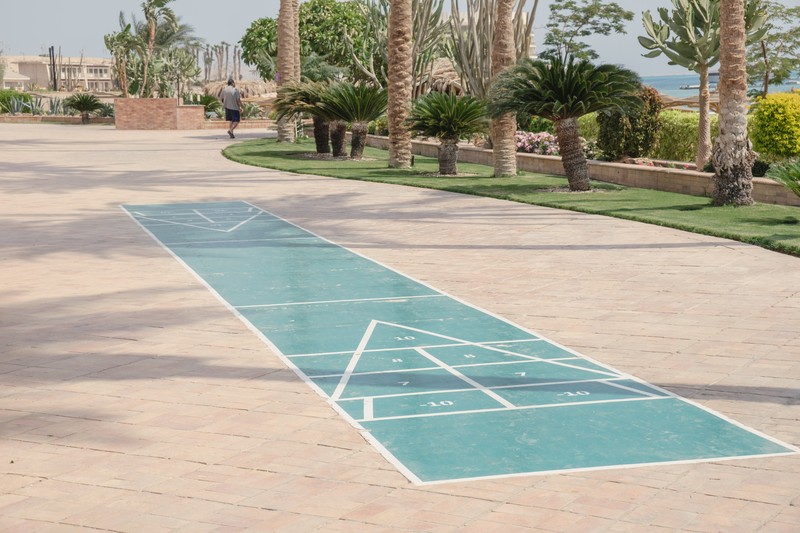
Before new lines are applied, it is worth confirming that court dimensions, scoring triangles, and baseline markings meet standard specifications. This is particularly important for clubs and communities that host organized shuffleboard leagues or tournaments, where consistent, accurately measured courts matter for fair competition.
Scheduling Around Weather Conditions
As with all outdoor resurfacing projects, shuffleboard resurfacing depends on dry, stable weather for both application and curing. Our team carefully monitors forecasts and works with clients to schedule projects during drier periods, minimizing delays and allowing the finished surface to cure properly before it reopens for play.
Why Precision Matters More for Shuffleboard
Shuffleboard is a sport of finesse, where a disc’s glide across the surface depends entirely on consistent texture and levelness. A basketball court with minor surface imperfections may still play acceptably, but a shuffleboard court with similar issues will noticeably affect how discs travel and score. This is why preparation for shuffleboard resurfacing often requires an extra level of attention compared to other sport surfaces.
Armor Courts brings the same commitment to precision and quality across every court type we service, including our dedicated shuffleboard court construction and resurfacing work. With over fifteen years of combined experience and a three-year guarantee on paint, our team understands what it takes to deliver a shuffleboard surface that performs the way players expect.
Property managers can also review our completed projects gallery for examples of shuffleboard courts we have resurfaced throughout South Florida.
Considering Nearby Amenities During Preparation
Shuffleboard courts at retirement communities and clubs are often part of a broader recreational complex, sometimes adjacent to shade structures, seating areas, or walkways.
Preparation should account for protecting these nearby amenities from dust, debris, and equipment during cleaning and repair work, and coordinating access so players and residents can move safely around the work zone.
Coordinating With Community Schedules
Because shuffleboard is frequently played by residents on a regular schedule, coordinating preparation and resurfacing timelines around community activities helps minimize disruption.
Many retirement communities and clubs prefer scheduling this work during lower-traffic periods of the day or week, and our team works with property managers to plan around these preferences whenever possible.
What Happens After Preparation
Once the surface is clean, repaired, and properly leveled, our team moves into applying the resurfacing system and finishing coats, followed by precise line marking. Because preparation is so foundational to shuffleboard’s unique playing requirements, we take the time needed at this stage so the finished court meets the high standards this sport demands.
Ready to restore your shuffleboard court’s smooth playing surface? Reach out to Armor Courts today for a free estimate.
Frequently Asked Questions
Why does shuffleboard court resurfacing require more precision than other courts?
Shuffleboard depends on disc glide across a perfectly smooth, level surface, so even minor texture or slope inconsistencies noticeably affect gameplay in ways other sports may not experience.
How often should a shuffleboard court be resurfaced?
Most outdoor shuffleboard courts benefit from resurfacing every five to eight years, depending on usage levels and climate exposure.
Can small cracks really affect shuffleboard play?
Yes, even hairline cracks can disrupt disc movement and scoring accuracy, making careful crack repair essential during preparation.
What causes uneven surfaces on shuffleboard courts?
Base settling, age-related wear, and prior resurfacing without proper leveling can all contribute to uneven shuffleboard court surfaces over time.
How long does shuffleboard court preparation typically take?
Preparation time varies with court condition, but most projects require one to two days of cleaning, repair, and leveling before resurfacing begins.