
Armor Courts
Tennis Court Resurfacing | Athletic Court Construction | Court Contractors/Builders

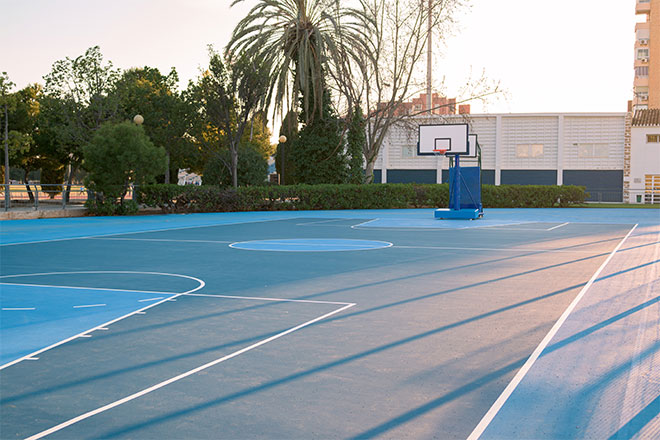 As pickleball participation continues to grow, many facilities are turning to existing basketball courts as a practical opportunity. Instead of constructing brand-new courts, it often makes financial and logistical sense to convert basketball courts to pickleball layouts within the current footprint. This approach reduces construction costs while maximizing available space.
That said, this is not simply a matter of painting a few extra lines. Proper conversion requires accurate layout planning, surface evaluation, professional striping, and, in many cases, resurfacing. When handled correctly, a converted court delivers clear markings, safe spacing, and consistent ball response for competitive play.
Below is a detailed look at how professionals convert a basketball court to a pickleball court.
Understanding Court Size Differences
Every project begins with a comparison of court dimensions. A full-size professional basketball court measures 94 feet long by 50 feet wide. High school courts are slightly shorter at 84 feet in length. A standard pickleball court measures 44 feet long by 20 feet wide.
Because pickleball courts are much smaller, a single basketball court can typically accommodate multiple pickleball layouts. Depending on spacing and safety allowances, two to four pickleball courts may fit within one basketball footprint. Careful planning accounts for both playing dimensions and the buffer zones surrounding each court.
Spacing and Safety Planning
The regulation pickleball playing area measures 44 by 20 feet, but safe play requires additional clearance beyond the boundary lines. Most facilities plan for:
- Several feet behind each baseline
- Adequate spacing along the sidelines
- Safe separation between adjacent courts
Without proper spacing, players may collide with fencing, walls, or other players during fast rallies. Licensed pickleball court designers use scaled drawings and on-site measurements to determine the most effective layout.
Court orientation is another important consideration. Outdoor layouts are commonly aligned north to south to reduce sun glare and improve player visibility.
Evaluating the Existing Basketball Surface
Before any effort to convert a basketball court to a pickleball court begins, the condition of the existing surface must be examined. Professionals inspect for:
- Surface cracks
- Low spots or drainage issues
- Faded or peeling coatings
- Uneven areas that affect ball bounce
If the base surface is concrete or asphalt, it may require cleaning, crack repair, or patching before conversion. Converting over a worn surface can lead to premature paint failure and inconsistent play. In many cases, resurfacing with a new acrylic coating system provides a clean foundation for pickleball striping.
Deciding Between Shared-Use and Dedicated Courts
Shared-Use Courts
Schools and recreation centers often maintain both basketball and pickleball on the same surface. In these cases, contrasting line colors clearly distinguish each sport.
Portable net systems are often selected for multipurpose court construction. These can be stored when basketball activities resume. Shared-use conversions focus heavily on visual clarity to prevent confusion during games.
Dedicated Pickleball Conversion
If pickleball becomes the primary activity, some facilities choose to reduce or eliminate basketball markings. This creates a cleaner look and improves concentration during play.
Dedicated projects typically include permanent net posts anchored into the slab. Many also feature new color-blocking that separates in-bounds and out-of-bounds areas for improved visual definition.
Professional Line Striping and Marking
Accurate line striping is one of the most technical aspects of conversion. Pickleball courts require clearly defined:
- Baselines
- Sidelines
- Non-volley zone lines
- Centerlines
The non-volley zone extends 7 feet from the net on both sides. Exact measurements are critical to maintain regulatory standards.
Sport-grade acrylic paint designed for compatibility with the existing coating system is used for striping. Specialized application equipment creates crisp edges and uniform thickness. High-contrast color selection improves visibility and reduces line-call errors during competitive matches.
Net Installation Options
A regulation pickleball net measures 36 inches high at the sidelines and 34 inches at the center. Facilities generally choose between two installation methods.
- Portable Net Systems
Portable nets are well-suited for shared-use environments. They maintain flexibility without permanent alterations to the playing surface. Quality systems include tension mechanisms and weighted bases to improve stability during matches.
- Permanent Net Posts
Dedicated courts often incorporate permanent net posts anchored directly into the surface. Installation requires precise drilling and secure footings beneath the slab. Permanent systems deliver greater stability, a more refined appearance, and less setup time between games.
Surface Upgrades During Conversion
Many projects reveal opportunities to enhance the overall playing surface. If the basketball coating is worn, applying a new acrylic system significantly improves traction and visual appeal. Modern sport coatings feature textured finishes that increase grip while remaining comfortable underfoot.
Some facilities select cushioned acrylic systems that include elastic layers beneath the top coat. These systems reduce joint stress during extended play and enhance overall comfort. Incorporating upgrades while you convert a basketball court to a pickleball layout can extend surface lifespan and elevate performance standards.
Managing Drainage and Slope
Outdoor courts require careful drainage evaluation before final layout approval. Low areas that collect standing water should be corrected prior to striping. Persistent moisture reduces coating durability and interferes with consistent ball bounce.
Surface leveling compounds or minor slope adjustments may be required. A licensed sports surfacing contractor analyzes the court’s grade to determine the best corrective approach. Proper drainage contributes to faster drying times and longer-lasting coatings.
Improving Visual Clarity
One of the biggest challenges in dual-athletic courts is visual clutter. Overlapping basketball and pickleball lines can confuse players.
Professional conversions often use:
- Distinct color schemes for each sport
- Slightly muted tones for secondary markings
- Color-blocked playing zones
This approach keeps the court organized and visually appealing. Clean line contrast also enhances player confidence during competitive matches.
Trusted Florida Athletic Court Construction Company
If you are planning to convert a basketball court into one or more pickleball courts, partner with Armor Courts. We specialize in professional athletic court construction and resurfacing in Florida, helping facilities transform existing courts into high-performance pickleball spaces.
As a family-owned company with over 15 years of combined experience, we handle everything from surface preparation and crack repair to precision striping and premium acrylic coatings. We also stand behind our work with a three-year guarantee on paint and a one-year guarantee on workmanship.
Ready to upgrade your court? Contact our team for results built for long-term play.