
Armor Courts
Tennis Court Resurfacing | Athletic Court Construction | Court Contractors/Builders

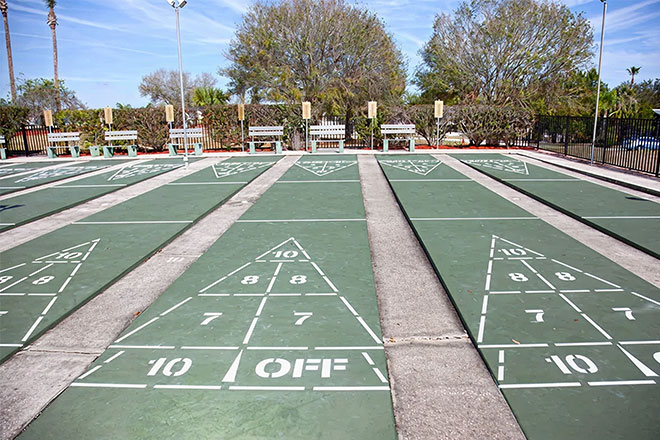
Shuffleboard courts have moved far beyond cruise decks and retirement communities. Homeowners, hospitality venues, and recreational facilities now view them as low impact, social playing surfaces that fit both compact and expansive layouts.
When people ask how much it costs to build a shuffleboard court, the answer depends on far more than surface size alone. Material selection, base conditions, installation method, and long-term maintenance planning, including future shuffleboard court resurfacing, all influence final cost.
Understanding these elements early helps align budget planning with realistic performance and longevity goals.
What Influences Shuffleboard Court Construction Cost
Shuffleboard court construction pricing reflects a combination of surface materials and groundwork. A court built over an existing concrete slab follows a different cost path than one requiring full base preparation. Outdoor courts must also account for drainage, UV exposure, and surface stability.
Indoor installations focus more on subfloor flatness and finish quality. Each decision shifts labor scope, material type, and total investment.
DIY Versus Professional Installation
DIY shuffleboard courts often rely on modular tile systems installed over a flat surface. These projects typically start around one thousand dollars for smaller home layouts and increase with size and customization.
DIY paths reduce labor expense but place responsibility for surface preparation and alignment on the owner. Professional installation carries a higher upfront cost but integrates base evaluation, surface precision, and long-term durability into the build.
Larger residential and commercial courts often favor professional installation due to scale and performance expectations.
Material Choices and Cost Impact
Surface material plays a defining role in overall pricing. Modular tile systems sit at the lower to mid range and appeal to homeowners seeking flexible layouts. Polymer coated concrete surfaces offer greater durability and consistent disc glide, though they increase cost due to surface prep and coating stages.
Fiberglass and specialty finishes land at the higher end of the spectrum, often selected for clubs or venues with heavy foot traffic. Material choice influences not only upfront cost but also maintenance frequency and surface lifespan.
Typical Price Ranges for Shuffleboard Courts
Home shuffleboard courts commonly range from one thousand to five thousand dollars when built over an existing base. Courts requiring concrete slabs or extensive grading often move into the three thousand to ten thousand dollar range or higher.
Larger or professionally specified courts exceed those figures based on square footage, finish complexity, and site conditions. Understanding these ranges helps frame expectations before design decisions are finalized.
The Role of Base Preparation
Base preparation often determines long-term court performance. A level, stable foundation supports accurate scoring zones and smooth disc travel. Sites without an existing slab require excavation, compaction, and concrete work, which adds meaningful cost.
Skipping base prep may reduce initial expense but often shortens surface life and raises future repair costs. Courts built on properly prepared bases hold shape longer and maintain consistent play.
Court Size and Layout Considerations
Standard shuffleboard courts demand more surface area than many homeowners expect. Larger layouts increase material volume and labor time. Custom dimensions, curved edges, or decorative scoring zones also affect pricing.
Residential courts often scale down dimensions to fit available space, while commercial installations follow regulation layouts for competitive play. Size choices should reflect how the court will be used rather than visual preference alone.
Customization and Visual Design Costs
Color schemes, scoring graphics, and logo work add character to a shuffleboard court but also increase cost. Simple single color courts remain budget friendly, while multi color layouts and branded designs require additional coating stages.
Outdoor courts may also integrate surrounding hardscape or seating zones, which expand project scope beyond the playing surface itself.
Indoor Versus Outdoor Cost Differences
Indoor shuffleboard courts benefit from controlled environments, which reduces weather related wear. Outdoor courts face sun exposure, moisture, and temperature shifts that influence material selection and prep methods. These environmental differences explain why outdoor projects often carry higher preparation and coating costs, even at similar sizes.
Budget Planning With Realistic Expectations
Understanding the cost to build a shuffleboard court requires balancing immediate budget limits with performance goals. Lower cost solutions suit light recreational use, while higher investment surfaces support frequent play and public access. Clear planning leads to courts that perform as expected without unexpected upgrades shortly after installation.
Start Your Shuffleboard Court Project With Armor Courts
We build shuffleboard courts with long-term play in mind, not short term shortcuts. Our team evaluates site conditions, usage goals, and surface options before moving forward.
With over fifteen years of combined experience, we guide clients through construction and resurfacing decisions that balance cost, durability, and consistent performance while backing our work with clear guarantees.